

If your ring and little fingers keep going numb, especially after bending your elbow to sleep, drive, or scroll your phone, it’s not something to shrug off. That tingling can be one of the earliest warning signs of ulnar nerve entrapment, a common nerve compression condition that can progress from mild irritation to lasting hand weakness if it’s ignored.
The good news: most people improve significantly with early, non-surgical care. Here’s what causes it, how it’s diagnosed, and which treatments actually work.
Quick Answer: What Is Ulnar Nerve Entrapment?
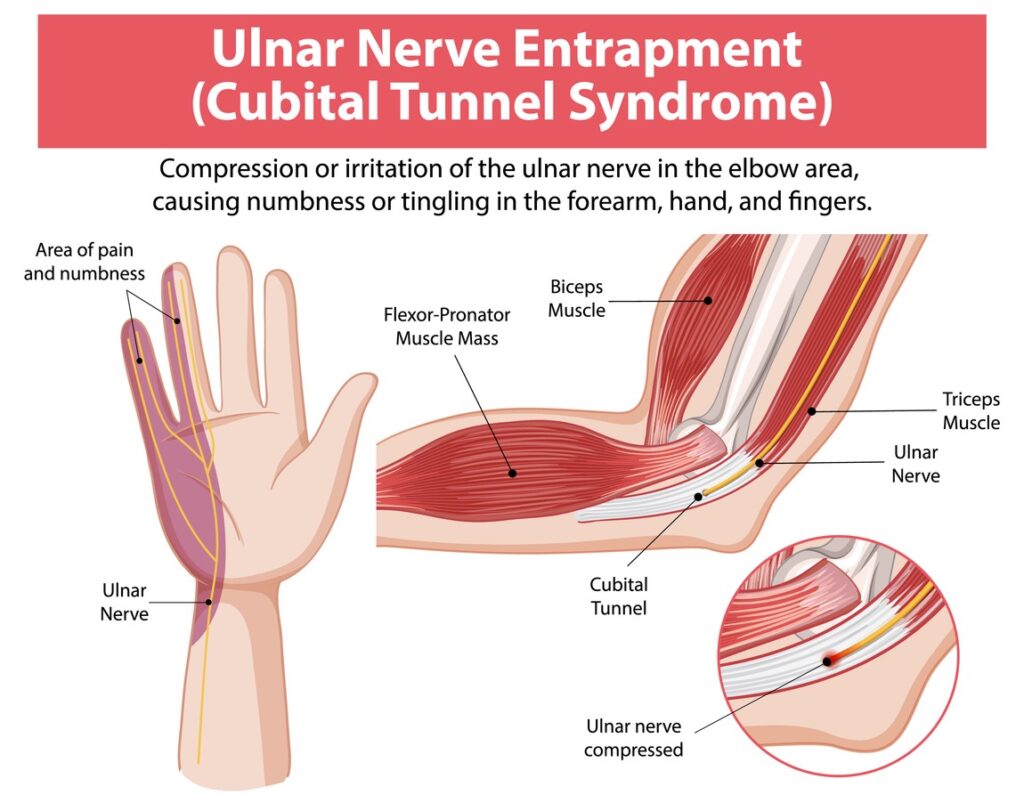
Ulnar nerve entrapment is compression of the ulnar nerve, most often at the elbow (cubital tunnel syndrome) and less commonly at the wrist (Guyon’s canal syndrome). It causes numbness and tingling in the ring and little fingers, hand weakness, elbow pain, and difficulty gripping objects. It’s the second most common nerve compression condition in the upper body, after carpal tunnel syndrome. Early diagnosis and treatment can help improve long-term outcomes.
What Does The Ulnar Nerve Do?
The ulnar nerve starts in the neck, runs down through the shoulder and arm, and passes through two tight anatomical “tunnels”, one at the elbow and one at the wrist, before ending in the hand. It’s often nicknamed the “funny bone” nerve because it sits so close to the skin at the elbow that even a light bump sends a jolt down the arm.
Because it controls both feeling and fine motor movement, sustained compression can affect everyday tasks, such as typing, buttoning a shirt, or opening jars, long before it becomes obviously painful.
What Causes Ulnar Nerve Entrapment?
Compression usually builds gradually, though it can also follow a direct injury. The most frequent contributing factors include:
- Repeated or prolonged elbow bending (phone use, sleeping with a bent arm)
- Leaning on the elbow for long stretches at a desk, armrest, or steering wheel
- Repetitive throwing or overhead motions in sports
- Occupations involving repetitive arm movement or vibrating tools
- A prior elbow fracture or dislocation that altered the joint’s anatomy
- Arthritis, bone spurs, cysts, or scar tissue narrowing the space around the nerve
Symptoms Of Ulnar Nerve Entrapment
Symptoms often develop gradually and may worsen when the elbow remains bent for long periods. As compression progresses, symptoms can begin affecting daily activities. Common symptoms include:
- Numbness Or Tingling: A “pins and needles” sensation affecting the ring and little fingers, especially when the elbow is bent.
- Hand Weakness: Difficulty gripping, lifting, or holding objects securely.
- Inner Elbow Pain: Aching or burning discomfort along the inside of the elbow that may extend into the forearm.
- Reduced Dexterity: Difficulty with activities requiring precise finger movements, such as typing, writing, or fastening buttons.
- Muscle Weakness Or Wasting: In severe or long-standing cases, prolonged nerve compression may lead to loss of muscle strength or shrinking of hand muscles.
A useful early-warning test: if bending your elbow fully for 30-60 seconds reproduces the tingling in your ring and pinky fingers, that’s a strong signal to get evaluated rather than wait it out.
Who Is At Risk For Ulnar Nerve Entrapment?
Anyone can develop ulnar nerve entrapment, but the risk climbs with repeated stress on the elbow or wrist. Higher-risk groups include:
- Athletes in baseball, tennis, golf, or weightlifting, due to repetitive arm loading
- Manual laborers and workers who use vibrating tools
- Desk workers who habitually lean on their elbows or keep their arms bent for long periods
- People with a prior elbow injury, arthritis, or anatomical variations that narrow the cubital tunnel

Diagnosing Ulnar Nerve Entrapment
Diagnosis starts with a physical exam, checking grip strength, sensation, and nerve irritation signs, such as tapping over the nerve to see if it reproduces tingling. If needed, imaging (X-ray, MRI, or ultrasound) can rule out arthritis, bone spurs, or soft tissue issues, while EMG and nerve conduction studies measure how well the nerve is functioning and gauge severity, helping guide whether conservative care or surgery is the better starting point.
Treatment Options
Most patients, especially those who start treatment early, improve without surgery. Conservative care focuses on taking pressure off the nerve: activity modification (avoiding repetitive bending or leaning), night splinting to keep the elbow from fully bending during sleep, medication for discomfort, and physical therapy, including nerve gliding exercises.
When conservative treatment doesn’t relieve symptoms or testing shows significant compression, ulnar nerve decompression surgery creates more space around the nerve through a cubital tunnel release, simple decompression, or nerve transposition. Surgery is typically considered when:
- Symptoms persist despite splinting, therapy, and activity changes
- Numbness or weakness is progressively worsening
- There’s visible muscle wasting in the hand
- Symptoms are interfering with work, sports, or daily tasks
Nerves that stay compressed for extended periods recover more slowly and less completely, even after successful surgery.
Recovery After Ulnar Nerve Surgery
Recovery depends on the severity of nerve compression, the procedure performed, and how long symptoms were present before treatment began. During the early healing period, patients focus on protecting the surgical site, reducing swelling, and maintaining gentle movement of the hand and fingers. As healing progresses, physical therapy may help restore motion, strength, and function. Many patients gradually return to work, sports, and daily activities as recovery continues. However, nerve recovery may take several months, particularly in patients who experienced symptoms for an extended period before treatment.

Frequently Asked Questions
Is ulnar nerve entrapment the same as cubital tunnel syndrome? Cubital tunnel syndrome is the most common type of ulnar nerve entrapment, caused by compression at the elbow. Compression at the wrist is called Guyon’s canal syndrome, but it’s far less common.
Can ulnar nerve entrapment go away on its own? Mild cases can improve with simple activity changes. But ongoing numbness, weakness, or muscle changes need evaluation, since untreated compression tends to worsen over time.
What does ulnar nerve entrapment feel like at night? Symptoms are often worse at night because the elbow stays bent for hours during sleep. Waking up with numb or tingling ring and pinky fingers is a common early sign.
How long does it take to recover from ulnar nerve decompression surgery? Relief often starts within weeks, but full nerve recovery can take several months, especially if compression was present for a long time before surgery.
Can I prevent ulnar nerve entrapment? Avoid prolonged elbow bending, don’t lean on your elbows for long periods, take breaks during repetitive arm activities, and use ergonomic supports at your workstation.
What’s the difference between ulnar nerve entrapment and carpal tunnel syndrome? Carpal tunnel affects the median nerve at the wrist, causing numbness in the thumb, index, and middle fingers. Ulnar nerve entrapment affects the ring and little fingers and usually occurs at the elbow.
When to See a Specialist
If you are experiencing numbness, tingling, weakness, or pain affecting your elbow, hand, or fingers, an evaluation by an orthopedic specialist can help determine the cause of your symptoms. At Peter Howard, M.D., we provide comprehensive evaluations and personalized treatment plans for ulnar nerve entrapment and other upper extremity conditions. Whether conservative treatment or surgery is recommended, our goal is to relieve nerve compression, restore function, and help you return to your daily activities with confidence. Schedule an appointment with Peter Howard, M.D., today to learn more about your treatment options.